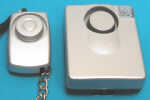
Frequently Asked Questions
What is the purpose of personal alarms?
These lightweight safety devices are extremely loud, usually 120 decibels or more.
This ear splitting high pitched sound is very uncomfortable to listen to for even a few seconds.
The intent is to surprise and disorient an attacker, allowing a few precious seconds you need to get away, while drawing attention to your situation.
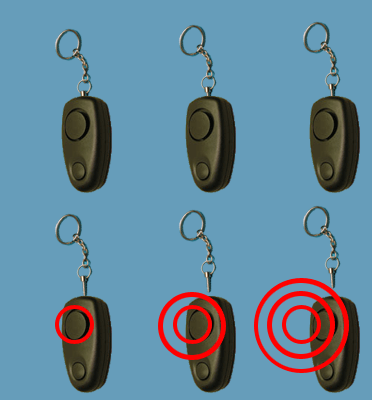 Most personal alarm systems are activated by pulling a cord, strap, or chain attached to a metal or plastic pin.
The alarm will sound as long as the pin is removed.
This is a great feature if you are attacked as you can pull the pin out and throw it to the ground.
Most personal alarm systems are activated by pulling a cord, strap, or chain attached to a metal or plastic pin.
The alarm will sound as long as the pin is removed.
This is a great feature if you are attacked as you can pull the pin out and throw it to the ground.
See how to use ALARM INSTRUCTIONS page.
Some alarms also have a small flashlight, which you can use to find keys in your handbag or the lock on the front door.
Planning ahead will help you to think more clearly in an emergency situation, and it is the best way to ensure your safety.
Best Type of Personal Security Alarm ...
Personal protection alarms have a number of features, and the need varies depending on the individual.
Is it Readily Available?
It is important to keep your personal alarm close at hand. Convenience is the single most important factor when choosing your alarm!
If you are attacked, it is likely to be a surprise, and an assailant will not wait around while you locate your alarm.
- Keychain Alarms (carried in hand) are best used by people at risk entering or leaving their automobiles or homes.
Ideal for shift workers who work until late in the evenings, or in parking garages and underground parking structures.
Built-in security light for night use.
- Snap Buckle Alarms attaches on to purse, or backpack for quick activation at any time.
Uses a pull cord (or wrist strap) which will sound the alarm when removed, and will not stop until the cord is re-inserted.
Great for students and shoppers, for protecting laptop computers, backpacks, or hand bags.
No thief wants to keep a bag with a siren attached (that draws too much attention), and will likely drop it.
- Back-Clip Style Alarms slips over belt or waistband for easy accessibility. Uses a pull cord which will sound the alarm when removed, and will not stop until the cord is re-inserted.
Best for outdoor enthusiasts (Walking, Hiking, Jogging, or Cycling).
- Door-Window Guard alarms can also be used to protect hotel rooms, dorm rooms and balcony doors, with optional switch cord.
Carry one with you when traveling for additional protection.
Size and Weight?
Each year personal alarms are getting smaller and louder!
As the technology advances they become more convenient and effective in a crisis situation.
The latest units are small as a match book and very loud.
Don't be stuck with an alarm that weighs as much as a small phone.
It must be Small enough to fit into the hands of women and children, yet convenient to carry at ALL times.
Check the Battery
Be sure you know what type of battery is used in your alarm.
Without power they are little more than decorative keychain fobs.
Is the battery readily available? Many alarms use 12V batteries that may not be carried at your local store.
Batteries also give you an indication of the weight of the alarm. Pad cells weigh far less than 9V or AA batteries.
Alarm Activation?
When I was first introduced to personal alarms I had this image of a trigger that looked more like a hat pin.
I did not understand how a person in crisis could take the time to locate this small ball of plastic and pull the pin
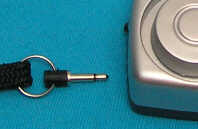
The truth is that the metal pull pin is usually attached to a wrist strap, key chain, or pull string.
This is not only quite convenient, but is actually an integral piece of information when selecting a personal alarm.
You want an alarm that you will carry and have it readily available when needed.
Attach one to your keys, your bag, or your luggage.
Relative Alarm volume
A recent review of personal alarms is shown in the following chart.
Alarms were tested at source (< 1 inch) with fresh batteries as shipped from manufacturing.
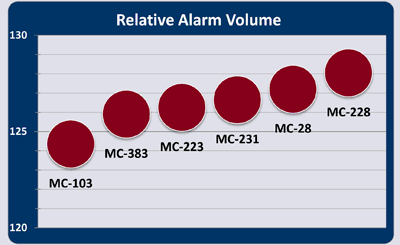
Slight differences (+/- 2dB) may appear due to manufacturing variability.
How Loud is Loud?
Intensity of sound (sound pressure) is measured in decibels (dB). Decibels are measured logarithmically.
This means that as decibel intensity increases by units of 10, each increase is 10 times the lower figure.
Thus, 20 decibel is 10 times the intensity of 10 decibels, and 30 decibels is 100 times as intense as 10 decibels.
| Approximate Decibels |
Examples |
| 0 |
the quietest sound you can hear |
| 30 |
whisper, quiet library |
| 60 |
normal conversation, sewing machine, typewriter |
| 85 |
smoke alarm |
| 90 |
lawnmower, shop tools, truck traffic, 8 hours per day is the maximum exposure (protects 90% of people) |
| 100 |
chainsaw, pneumatic drill, snowmobile; 2 hours per day is the maximum exposure without protection |
| 105-110 |
MC-311,MC-683 |
| 115 |
sandblasting, loud rock concert, auto horn; 15 minutes per day is the maximum exposure without protection. |
| 120 |
MC-223,MC-231, MC-383 |
| 130 |
MC-28, MC-228 |
| 140 |
gun muzzle blast, jet engine; Noise causes pain and even brief exposure injures unprotected ears. Maximum allowed noise with hearing protector. |
|
|
|
Shipping Costs |
A flat rate shipping fee of $6.50 will be applied to each Order.
See Wholesale & Discount Orders for quotes over 10 alarms.
|
|